
Vadiati v. Canada: Key Insights on Military Service
The federal court decision in Vadiati v. Canada (2025 FC 1859) has sparked debate among Iranians regarding military service and IRGC connections. While some view it as a complete closure, others se...
Mehdi Nafisi
11/30/20252 min read
Vadiati v. Canada (2025 FC 1859): Iranian Military Service and IRPA s.34
Summary
The Federal Court decision in Vadiati v. Canada (Citizenship and Immigration), 2025 FC 1859 addresses how Canadian law analyzes alleged IRGC involvement under IRPA s.34. It does not create automatic outcomes for Iranian conscripts and does not exempt military service by default.
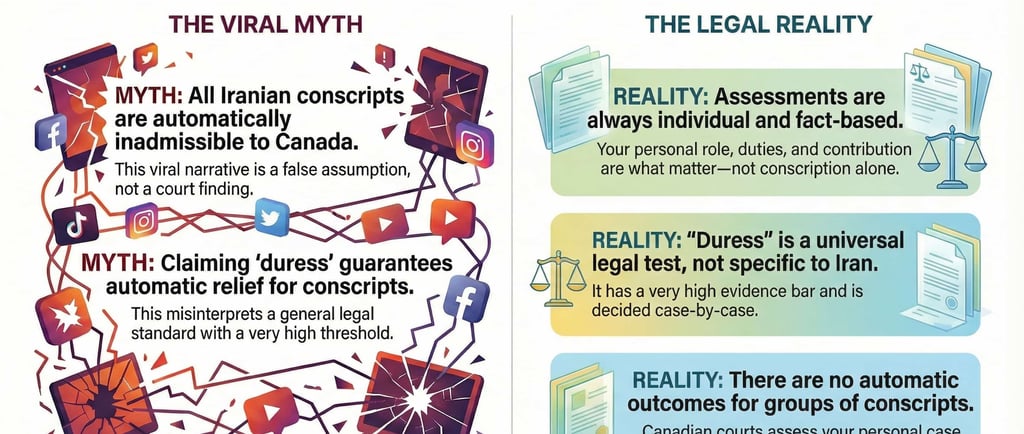
This decision is often misquoted on Persian social media. Some claim it protects all conscripts, others claim it bans them all. Both interpretations are incorrect.
What Was the Legal Issue?
IRCC refused the applicant’s permanent residence application under IRPA s.34(1)(f) for alleged membership in or contribution to the IRGC (Sepah).
The refusal was based on:
alleged organizational involvement,
not military service alone.
The applicant argued that his service was compulsory. The Court reviewed that argument but still upheld the refusal.
Did the Applicant Win?
No.
The Federal Court upheld the refusal.
Security inadmissibility remained in place.
This means:
there is no court ruling saying conscription automatically protects someone, and
there is no court ruling banning all conscripts.
How Does Duress Apply?
Canadian law uses a strict duress test derived from R v. Ryan.
It is:
not Iran-specific,
not automatic, and
not triggered simply by mandatory service.
Officers must assess:
the person’s role,
the nature of their duties,
the evidence of coercion or pressure.
Claiming “I had no choice” is not enough by itself.
Can Humanitarian and Compassionate Grounds Fix IRPA s.34?
No.
The Court confirmed that H&C (IRPA s.25) cannot overcome security inadmissibility under IRPA s.34.
This is important for applicants who assume H&C is a solution to terrorism-related findings. It is not.
What This Decision Does NOT Do
It does NOT:
make all Iranian conscripts inadmissible,
excuse all military service under pressure,
create nationality-based rules,
or create automatic outcomes.
Security inadmissibility remains:
individual,
fact-specific,
and evidence-driven.
Practical Guidance
Always disclose military history accurately.
Do not assume conscription equals safety.
IRGC-related allegations are high-risk and must be analyzed carefully.
Do not rely on social media interpretations of case law.
Each case depends on:
role,
duties,
documentation,
and credibility.
If your history includes military service or alleged IRGC involvement, your situation requires careful legal analysis. Request a consultation to assess your risk before submitting any application.
© 2025. All rights reserved.
Strategic. Human. Results-driven. Complete Canadian immigration services for visas, PR, and complex cases. We go beyond paperwork.
Menu


Legal Notices
Resources