

Medical Inadmissibility Canada cost thresholds (2026 Update)
Medical Inadmissibility Cost Threshold Increased in Canada
Medical inadmissibility is one of the most misunderstood areas of Canadian immigration. Many applicants believe that having a medical condition automatically leads to refusal. That is not how the law works.
Medical inadmissibility in Canada is primarily about cost, not diagnosis.
Canada applies a cost threshold when assessing whether an applicant’s health condition would place an excessive demand on public health care or social services. This framework has existed for decades and is well established in immigration law. What has changed is the allowable cost threshold, which has increased.
This increase means that more applicants with manageable or well controlled medical conditions may now fall below the limit, depending on their individual circumstances.
What Is Medical Inadmissibility in Canada
Medical inadmissibility applies when an applicant is found to:
Be a danger to public health, or
Be a danger to public safety, or
Cause excessive demand on health or social services
The third category, excessive demand, is where most refusals occur and where the cost threshold matters.
In practical terms, immigration medical officers assess whether the expected cost of treatment, medication, and services for an applicant is likely to exceed the allowable threshold over a defined period.
Medical inadmissibility is assessed by Immigration, Refugees and Citizenship Canada, based on medical examinations, specialist reports, treatment plans, and cost projections.
What Is the Medical Cost Threshold
The medical cost threshold represents the maximum projected cost that an applicant’s condition can place on Canada’s publicly funded systems without triggering a finding of excessive demand.
If the projected cost remains below the threshold, medical inadmissibility generally does not apply.
If the projected cost is well above the threshold, the applicant may be found medically inadmissible unless mitigation or exemptions apply.
The recent increase to this threshold reflects rising health care costs and updated policy considerations. It does not eliminate medical inadmissibility, but it does change how many cases fall above or below the line.
Why Diagnosis Alone Does Not Determine Inadmissibility
A common mistake is assuming that certain diagnoses automatically result in refusal. That is incorrect.
Canadian immigration law does not refuse applications based solely on the name of a condition. Instead, it looks at:
The severity of the condition
Whether it is stable or progressive
The expected treatment plan
Medication requirements
Frequency of medical services
Associated social service needs
Projected costs over time
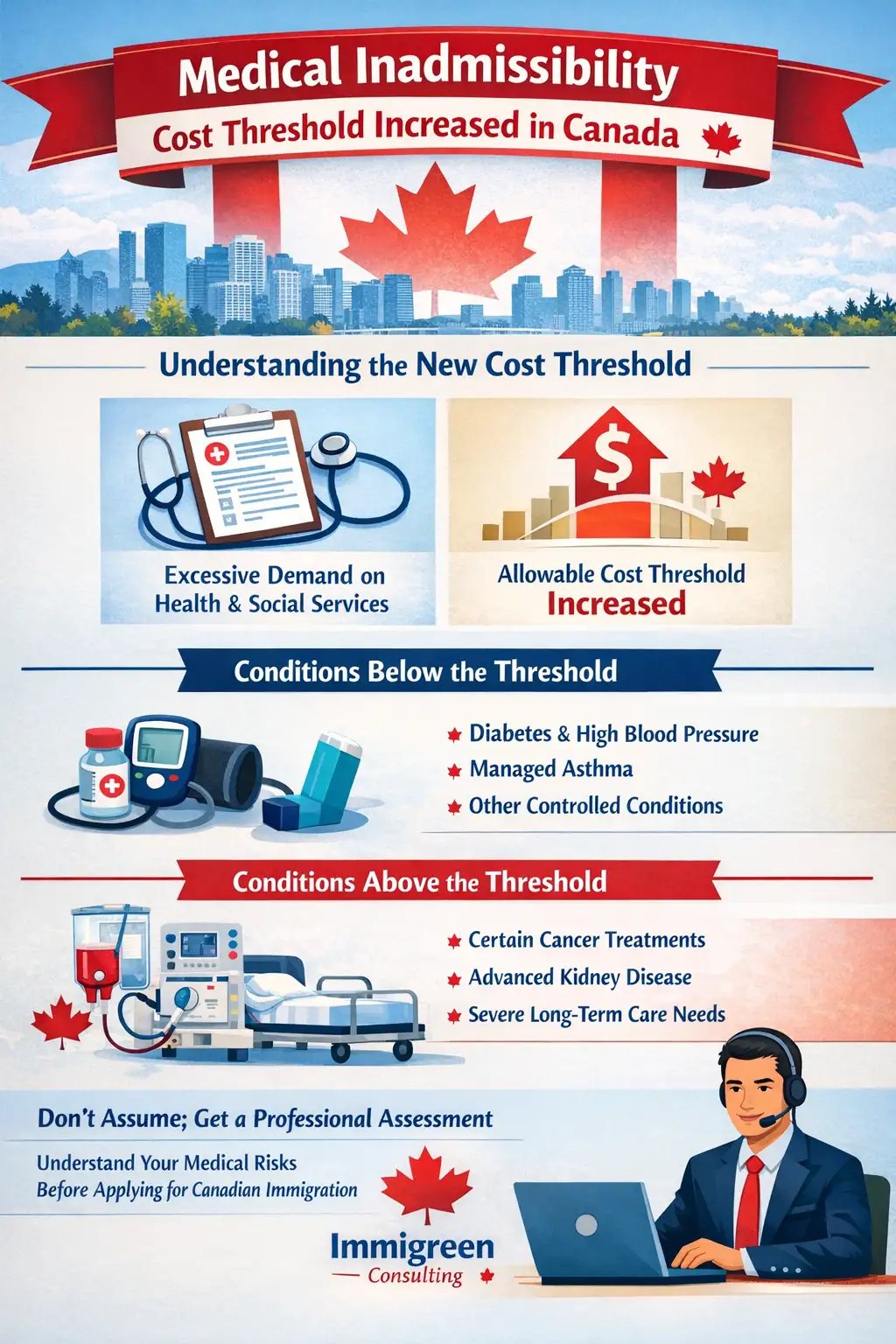
For example, many applicants with diabetes, high blood pressure, asthma, or other chronic but well managed conditions fall far below the cost threshold.
On the other hand, some conditions involving complex therapies, frequent hospitalizations, or long term institutional care may exceed the threshold, even if the diagnosis itself is not uncommon.
Examples of Conditions Below and Above the Threshold
Typically below the threshold (case dependent):
Type 2 diabetes managed with medication
Controlled hypertension
Mild asthma
Stable thyroid disorders
Managed mental health conditions with outpatient care
These conditions often involve predictable, relatively low annual costs.
Potentially above the threshold (case dependent):
Certain cancer treatments requiring long term chemotherapy or biologics
Advanced kidney disease requiring dialysis
Severe developmental disabilities requiring extensive social services
Progressive neurological conditions with high care needs
These cases are assessed individually. There is no automatic refusal list.
How IRCC Assesses Excessive Demand
When a medical condition is identified, an immigration medical officer may calculate projected costs based on:
Provincial health care pricing data
Standard treatment protocols
Specialist recommendations
Medication costs
Frequency of services
If the officer believes the projected costs exceed the threshold, the applicant is typically issued a Procedural Fairness Letter. This letter provides an opportunity to respond.
A proper response may include updated medical evidence, alternative treatment plans, private payment strategies where allowed, or clarification of actual service needs.
Exemptions From Medical Inadmissibility
Not all applicants are subject to excessive demand rules.
Certain categories are exempt, including:
Sponsored spouses and common law partners
Dependent children
Some humanitarian and compassionate cases
For non exempt applicants, careful planning and documentation become especially important when medical issues exist.
Why This Threshold Increase Matters
The increased threshold means that some applicants who may previously have been close to or slightly above the limit may now fall below it.
This does not mean approvals are automatic. It does mean that proper analysis matters more than assumptions.
Applicants should not self exclude or abandon an application solely due to a medical diagnosis without understanding how costs are assessed.
Practical Advice for Applicants With Medical Conditions
If medical issues are part of your immigration application:
Do not assume refusal based on diagnosis
Ensure medical records are current and accurate
Understand how your condition is treated in Canada
Be prepared to respond if cost concerns are raised
Seek professional analysis before drawing conclusions
Medical inadmissibility cases are technical and evidence driven. Strategy matters.
If medical issues may affect your immigration application, a proper assessment matters. Contact Immigreen Consulting to review your situation before making assumptions.
Mehdi is a Regulated Canadian Immigration Consultant (RCIC-IRB), an immigrant himself who has lived most of his life in Canada. He carries a deep passion for helping others navigate the same system that once shaped his own journey.
With a background spanning IT, healthcare, and business, Mehdi brings a rare combination of analytical precision and human understanding to every case. Before founding Immigreen Consulting, he spent years working in the health sector and technology fields, developing the problem-solving skills and empathy that now define his approach to complex immigration cases.
As a father, advocate for dignity and fairness, and someone who believes in second chances, Mehdi specializes in challenging applications—from humanitarian and compassionate PR cases to residency obligation appeals, spousal sponsorships, and refused visa re-applications. His work is guided by one simple principle: every client deserves trusted, human-centered representation and a voice that’s heard.
Outside his practice, Mehdi is an aviation enthusiast, lifelong athlete, and former martial arts competitor. He has volunteered with youth programs, taught martial arts, and supported foster children in care homes. He has also tutored underprivileged students, continuing his lifelong mission of helping people grow, belong, and thrive.


I treat every case like it’s personal. Because for my clients, it is.
About the author, Mehdi Nafisi
Contact us
If you’re facing challenges with your case or just want to get it right the first time, reach out today. We’re here to help.
Every story is unique
© 2025. All rights reserved.
Strategic. Human. Results-driven. Complete Canadian immigration services for visas, PR, and complex cases. We go beyond paperwork.
Menu


Legal Notices
Resources