

What Recent Express Entry Draws Tell Us About CRS Scores
A Clear, Practical Guide for PR candidates.
Are CRS Scores Going Up or Down in 2026?
If you have been watching Express Entry draws and wondering whether your score is competitive, you are not alone. Most candidates check the latest cut-off number and feel either relieved or discouraged — but a single draw number rarely tells the full story. What matters more is the pattern behind the numbers, and what your options are based on where your profile stands today. This page breaks down recent draw trends, explains the policy shifts shaping the system in 2026, and helps you understand what to do next.
The short answer is that CRS scores are not moving in a straight line. They follow a wave pattern, rising when the candidate pool grows more competitive and falling when larger numbers of invitations are issued.
Understanding this pattern is more useful than focusing on any single draw result.
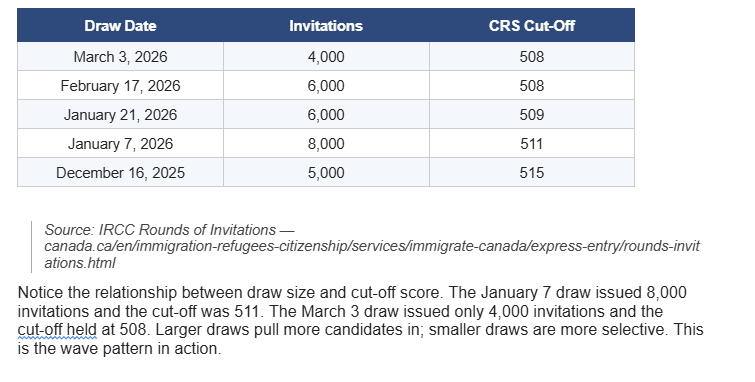
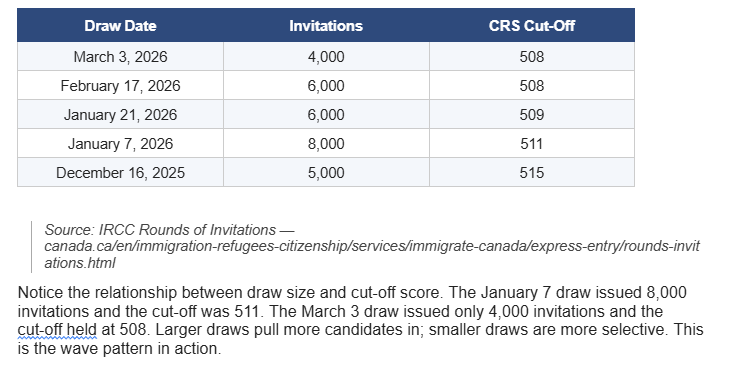
Express Entry invitation rounds for the Canadian Experience Class (CEC) in early 2026 have settled in a consistent range above 500:
Source: IRCC Rounds of Invitations — canada.ca/en/immigration-refugees-citizenship/services/immigrate-canada/express-entry/rounds-invitations.html
Notice the relationship between draw size and cut-off score. The January 7 draw issued 8,000 invitations and the cut-off was 511. The March 3 draw issued only 4,000 invitations and the cut-off held at 508. Larger draws pull more candidates in; smaller draws are more selective. This is the wave pattern in action.
What CRS Score Is Currently Competitive for Express Entry?
Based on recent Canadian Experience Class draws, here is a practical way to read your position:
500 and above — You are competitive for standard CEC draws. The main variable is timing and draw size.
460 to 499 — You are not competitive for CEC draws in the current environment, but you likely have real options. Language improvement, a provincial nomination, or French proficiency could change your position significantly.
Below 450 — Standard draws are unlikely to reach your score without a meaningful change to your profile. This is where strategy matters most.
One important note: category-based draws operate under completely different cut-offs. A CRS score of 397 was sufficient to receive an invitation in the most recent French-language draw. Your overall CRS score is not the only number that matters.
Category-Based Draws Changed Everything
In 2023, IRCC introduced category-based Express Entry draws — a significant shift that changed how many candidates should think about their options.
Instead of competing only in a general pool, candidates with specific profiles are now invited through targeted rounds. These draws have substantially lower CRS cut-offs than standard CEC draws.
What Are the Latest Category-Based Express Entry Draws?
Recent French-language category draws offer a clear illustration of how different these cut-offs can be:
March 4, 2026 — 5,500 invitations — CRS cut-off 397
February 6, 2026 — CRS cut-off 400
Compare those numbers to the standard CEC cut-offs of 508 to 515 in the same period. The difference is more than 100 points.
Which Categories Currently Have the Lowest CRS Cut-Offs?
IRCC has used category-based draws for candidates in the following areas:
French language proficiency
Healthcare occupations
Skilled trades
Education occupations
STEM occupations
Category eligibility is based on your occupation, language results, and other profile factors. Not every candidate qualifies, but many more do than realize it. This is one of the first things worth checking in a profile review.
What Canada's 2026–2028 Immigration Levels Plan Means for Express Entry Candidates
Understanding recent draw scores requires understanding the broader policy direction behind them.
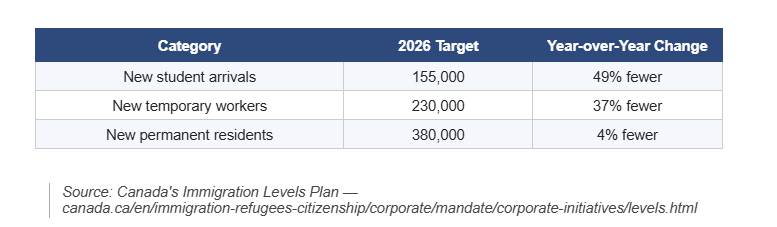
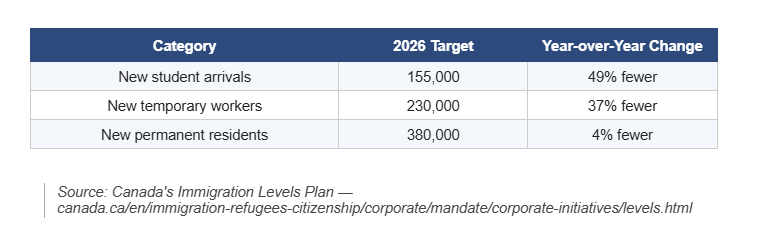
In late 2025, IRCC released its 2026–2028 Immigration Levels Plan with a significant shift in tone. The government is explicitly prioritizing balance and sustainability, reducing temporary resident targets sharply while keeping permanent resident admissions relatively stable.
Source: Canada's Immigration Levels Plan — canada.ca/en/immigration-refugees-citizenship/corporate/mandate/corporate-initiatives/levels.html
For Express Entry candidates, three things from this plan stand out:
1. Permanent residence remains the priority
Despite cuts to temporary immigration, PR targets are only marginally reduced. Economic immigration will account for 64% of all immigration in 2027 and 2028 — described by IRCC as the highest proportion in decades. The pathway to PR through Express Entry remains intact and intentional.
2. Sector focus is sharpening
The plan explicitly prioritizes emerging technologies, healthcare, and skilled trades. Candidates in these sectors — or those eligible for category-based draws targeting them — are aligned with where government policy is heading. This matters for both draw frequency and provincial nomination stream availability.
3. A one-time initiative for skilled workers already in Canada
IRCC is fast-tracking approximately 33,000 skilled temporary workers already in Canada to permanent residence over 2026 and 2027, with a focus on in-demand sectors and rural areas. If you are currently working in Canada on a work permit, this initiative may be directly relevant to your timeline.
So What Does This Mean for Your PR Application?
Canada's immigration system is not closing — it is recalibrating. The 2026–2028 Levels Plan makes clear that permanent residence through economic pathways remains a government priority. The system is becoming more defined about who gets invited and through which stream.
Your CRS score is a starting point, not a verdict.
The more useful question is not “Is my score high enough?” but “Am I using the right pathway for my profile?”
Candidates who succeed are typically those who understand the system well enough to position themselves within it — whether that means improving a language score, qualifying for a category-based draw, pursuing a provincial nomination, or timing an application around a targeted initiative.
What If My CRS Score Is Too Low for Recent Draws?
A low CRS score is not a dead end. It is a signal that your current profile needs a strategic adjustment. Here are five paths worth examining:
1. Improve your language score
Language is the single highest-leverage factor in CRS scoring. A meaningful improvement in your IELTS or CELPIP result can add 20 to 50 points or more depending on your current scores. If you have not tested at CLB 9 or above, this is usually the first place to look.
2. Add French language points
You do not need to be fluent. Even intermediate French proficiency — tested through TEF Canada or TCF Canada — can add meaningful CRS points and may qualify you for category-based draws with significantly lower cut-offs.
3. Pursue a provincial nomination
A provincial nomination through an Express Entry-aligned stream adds 600 points to your CRS score — effectively guaranteeing an invitation to apply. This is the most reliable path for candidates with strong profiles who are not competitive in federal draws. Not every province is accessible to every candidate, but eligibility is broader than many people assume.
Express Entry PNP vs. Non-Express Entry PNP
4. Gain Canadian work experience
If you are currently working in Canada on a work permit, additional Canadian work experience adds CRS points and may strengthen or open eligibility for the Canadian Experience Class. Even one additional year can shift your score meaningfully.
5. Optimize your spouse’s credentials
If you have a spouse or common-law partner, their language scores and education credentials factor into your combined CRS score. Many couples are leaving points on the table simply because one partner has not been assessed.
FAQ About Work Experience and Express Entry
Does Work Experience Outside Canada Count for Express Entry?
Yes — foreign work experience does count, particularly under the Federal Skilled Worker (FSW) program. Canadian experience is not a requirement for FSW, though it does add additional CRS points when present. Candidates applying through FSW are assessed on their foreign work history, education, language results, and other factors.
If you have no Canadian experience but have strong foreign credentials and language scores, FSW may be the right program for your profile.
Does Express Entry Work Experience Have to Be Recent?
The recency requirement depends on which program you are applying through. Under the Federal Skilled Worker program, work experience within the past 10 years is assessed. Under the Canadian Experience Class, your qualifying work experience must fall within the last 3 years. Understanding which program applies to your profile directly affects how your work history is evaluated.
Is One Year of Work Experience Enough for Express Entry?
One year of continuous full-time skilled work experience is typically the minimum threshold for Express Entry eligibility. That said, eligibility and competitiveness are two different things. Meeting the minimum gets you into the pool; additional years of experience increase your CRS score and strengthen your overall profile.
Does Six Months of Work Experience Help My CRS Score?
Six months of work experience alone is generally not enough to meet the minimum eligibility threshold for most Express Entry streams. However, it can still factor into your CRS calculation in certain circumstances, particularly if combined with other qualifying experience. If you are approaching the one-year mark, it is worth understanding exactly how your experience will be counted before submitting.
Frequently Asked Questions
What CRS score is needed for Canada PR in 2026?
For standard Canadian Experience Class draws in early 2026, the cut-off has been consistently above 500. However, category-based draws have significantly lower cut-offs — some as low as 397 for French-language candidates. The score you need depends on which stream you qualify for.
Can I get PR with a 450 CRS score?
A score of 450 is below current cut-offs for standard CEC draws. However, it may be sufficient for some provincial nomination programs or category-based draws depending on your profile. A 450 score combined with a provincial nomination would place you well above any current cut-off.
Why is my CRS score lower than I expected?
Common reasons include language scores below CLB 9, limited Canadian work experience, age deductions if you are over 35, or not having a post-secondary credential assessed. Each of these factors can be addressed. Reviewing your full profile often reveals where points are being lost.
How often does IRCC hold Express Entry draws?
IRCC typically holds draws every two weeks, though the frequency and category can vary. Some months have seen three or four rounds; other periods have had pauses. Monitoring the official IRCC rounds page is the most reliable way to stay current.
How a Provincial Nomination Changes Your CRS Score
A provincial nomination through an Express Entry-aligned stream adds 600 points directly to your CRS score. Given that current CEC draw cut-offs are around 508 to 515, a candidate with a score of 400 who receives a provincial nomination would be ranked far above the cut-off. This is why PNP pathways are one of the most discussed strategies for candidates below competitive CRS thresholds.
Express Entry PNP vs. Non-Express Entry PNP
Who We Are and How We Can Help
Immigreen is a Canadian immigration consulting practice. We work with individuals and families on permanent residence applications, Express Entry profiles, provincial nomination programs, spousal sponsorships, and related immigration matters.
We are regulated immigration consultants, not attorneys. Our work is grounded in IRCC program requirements, IRPA and IRPR, and a thorough understanding of how the system actually operates in practice — not just on paper.
The clients we work with are typically at a decision point. They have done some research, they understand the basics, and they want a clear picture of their actual options — not a general answer.
If you have read this far, you are probably one of those people.
Is Your CRS Score Holding Back Your PR Application?
Every immigration profile is different. Two candidates with the same CRS score can have very different options depending on their occupation, language results, province of interest, and work history.
We review your full profile, identify which pathway fits your situation, and give you a clear next step — not a general answer.
This content is for general informational purposes only and does not constitute legal or immigration advice. Immigration requirements and policies change regularly. For advice specific to your situation, consult a regulated Canadian immigration consultant or authorized representative.
Mehdi is a Regulated Canadian Immigration Consultant (RCIC-IRB), an immigrant himself who has lived most of his life in Canada. He carries a deep passion for helping others navigate the same system that once shaped his own journey.
With a background spanning IT, healthcare, and business, Mehdi brings a rare combination of analytical precision and human understanding to every case. Before founding Immigreen Consulting, he spent years working in the health sector and technology fields, developing the problem-solving skills and empathy that now define his approach to complex immigration cases.
As a father, advocate for dignity and fairness, and someone who believes in second chances, Mehdi specializes in challenging applications—from humanitarian and compassionate PR cases to residency obligation appeals, spousal sponsorships, and refused visa re-applications. His work is guided by one simple principle: every client deserves trusted, human-centered representation and a voice that’s heard.
Outside his practice, Mehdi is an aviation enthusiast, lifelong athlete, and former martial arts competitor. He has volunteered with youth programs, taught martial arts, and supported foster children in care homes. He has also tutored underprivileged students, continuing his lifelong mission of helping people grow, belong, and thrive.


I treat every case like it’s personal. Because for my clients, it is.
About the author, Mehdi Nafisi
Contact us
If you’re facing challenges with your case or just want to get it right the first time, reach out today. We’re here to help.
Every story is unique
© 2025. All rights reserved.
Strategic. Human. Results-driven. Complete Canadian immigration services for visas, PR, and complex cases. We go beyond paperwork.
Menu


Legal Notices
Resources